



Choosing a business internet link seems like a simple task until the first fiber optic break paralyzes your operation for hours. In a digital economy, network availability at a branch is as important as electricity itself. However, the challenge for infrastructure managers is that not all locations have the same geographical or technical conditions.
The solution for uninterrupted uptime doesn't lie in choosing a single technology, but rather in understanding the strengths of each to build a hybrid connectivity. In this guide, we will analyze how Fiber, Satellite, Radio, and Mobile Networks behave and how to combine them to eliminate single points of failure.
Fiber Optic: The High-Performance Foundation
Fiber optic is, without a doubt, the star when it comes to bandwidth capacity and low latency. For applications that require intense data traffic, such as local servers and VoIP, it is the gold standard.
However, its greatest strength is also its vulnerability: the physical infrastructure. Being subject to public road works or accidents involving poles makes fiber a "fragile link" if it's the only option. Therefore, in a network redundancyproject, fiber should be your primary link, but never the only one, especially in dense urban centers.
Radio and Satellite: Security From Above
When terrestrial infrastructure fails, the sky is the answer.
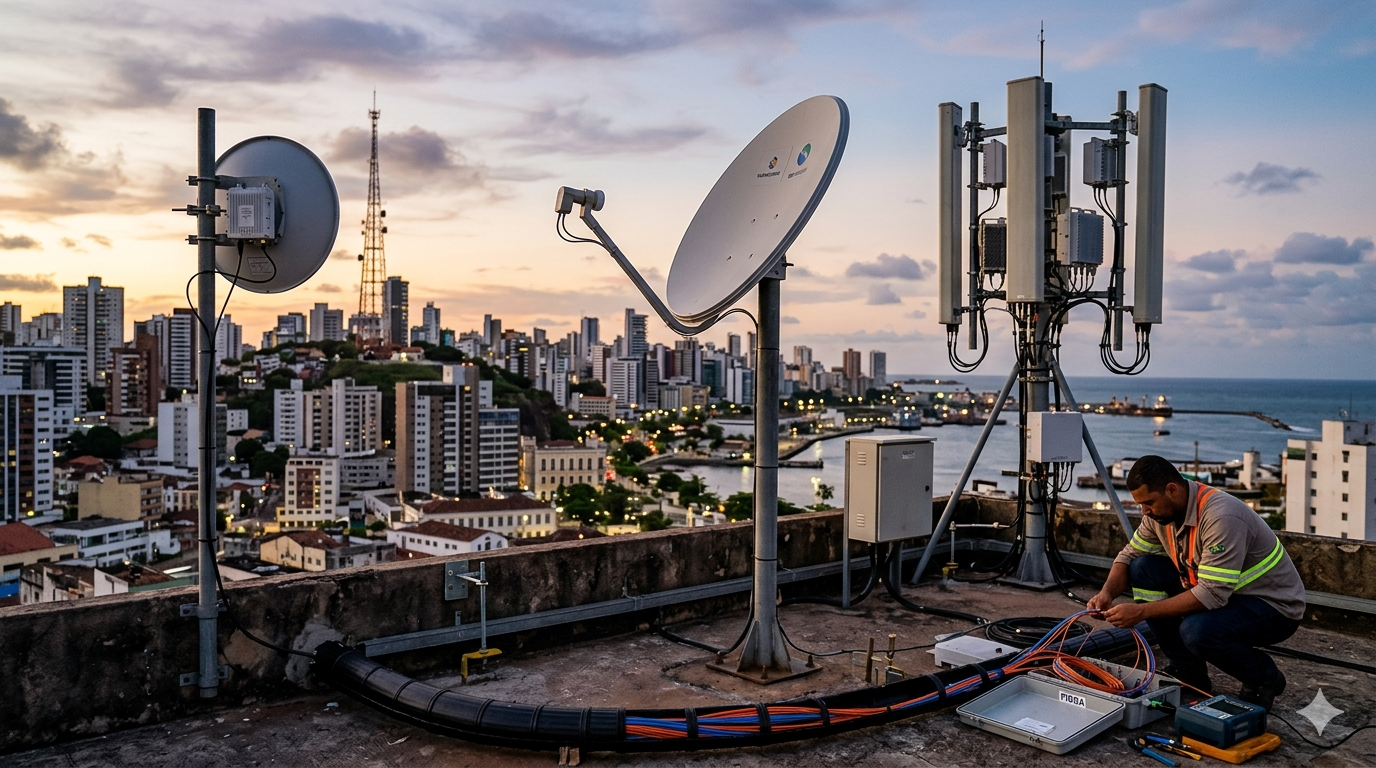
- Radio Link: Ideal for businesses with a direct line of sight to transmission towers. It offers extremely low latency and is immune to ground issues (cable cuts), making it excellent for redundancy in industrial districts.
- Satellite (LEO - Low Earth Orbit): The great revolution for remote locations. With new low-orbit constellations, latency has drastically decreased, making satellite an important arm of hybrid connectivity where fiber doesn't reach.
Mobile Networks (4G/5G): Versatility and Agility
Mobile connectivity has evolved from an emergency backup resource to a robust solution for high availability. The use of 4G and 5G for businesses offers a layer of redundancy that does not depend on cables or complex fixed external antennas.
- Immediate Implementation: Unlike fiber, cellular can be activated instantly, making it ideal for temporary units or rapid deployments.
- Mobility and Stability: With industrial routers, the mobile network provides an extremely reliable failover for POS transactions and critical systems, ensuring that operations continue even if all physical means are compromised.
Hybrid Connectivity: The Perfect Mix for Your Branch
Operational intelligence today lies in the diversity of means. Building the perfect mix means ensuring that data paths are physically distinct.
A recommended configuration for high availability includes a primary Fiber Optic link and a secondary link via Radio or Satellite. The 4G/5G connection comes in as the third layer of security (last resort), ensuring total redundancy. Through technologies like SD-WAN, this transition occurs in milliseconds, keeping POS, ERP, and communications active without the user noticing the primary link's failure.
There is no single solution that meets all geographies with 100% security. The secret to a resilient infrastructure lies in diversification. By investing in a business internet link that combines terrestrial, aerial, and mobile means, your branch gains autonomy and security. Operational efficiency stems from intelligent redundancy and the end of dependence on a single physical path.


