



The complaint is universal: "The internet is slow." For many managers, the immediate solution seems to be upgrading their broadband plan. However, in an overwhelming percentage of cases, the problem isn't the amount of megabytes contracted, but rather the lack of control over how they are distributed.
Without proper real-time network monitoring, your company operates in the dark. Slowdowns can be caused by an unauthorized download, a mass system update, or a router bottleneck. Understanding the difference between a poor connection and a poorly managed network is what separates productive companies from those that lose valuable hours to technical idleness .
Traffic Visibility: The X-Ray of Your Connectivity
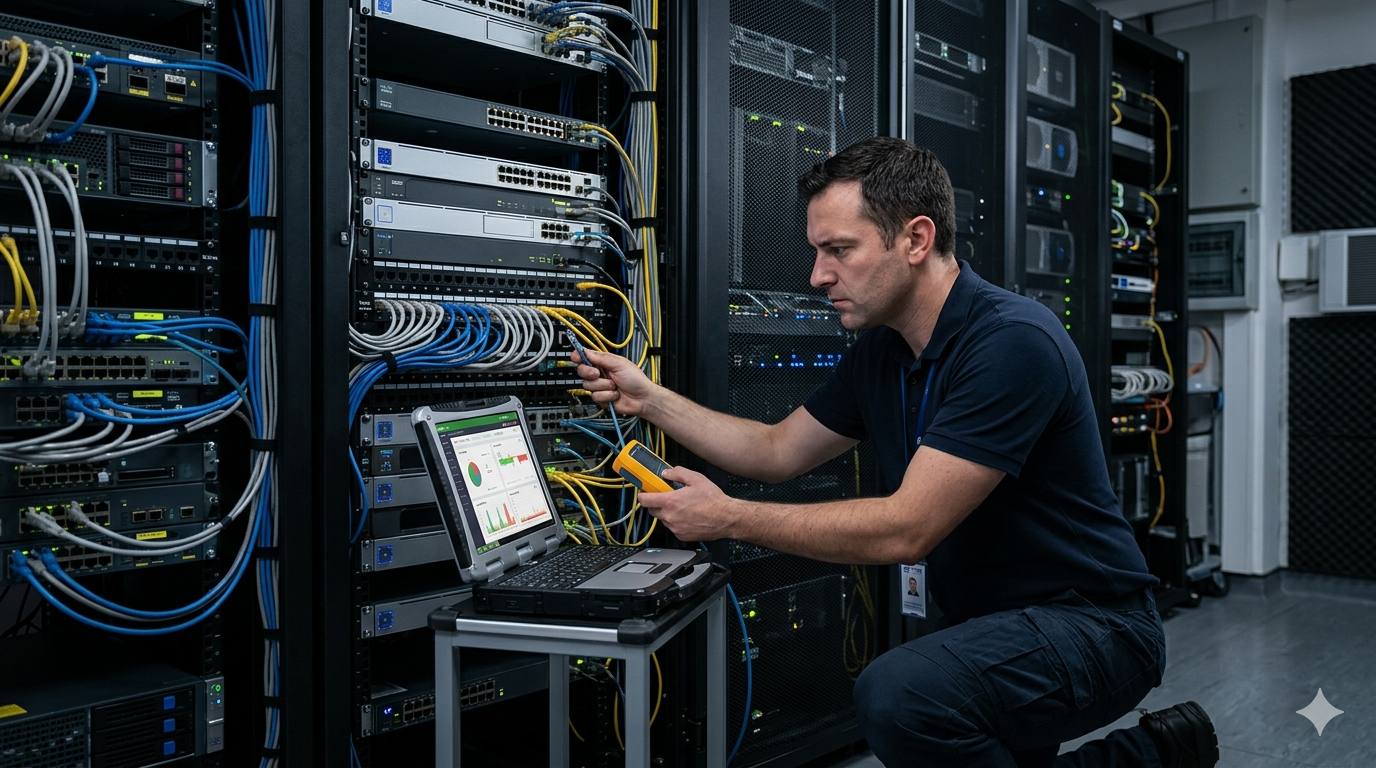
Data traffic management begins with visibility. Imagine being able to visualize, in a simple graph, exactly how much of your bandwidth is being consumed by your ERP, video calls, and social media.
Having this insight allows you to identify "bandwidth hogs." Often, backup applications configured for business hours or automatic operating system updates consume 40% of the network without anyone noticing. With the right visibility, IT stops "guessing" and starts "knowing," acting directly on the point of congestion.
Network Performance vs. Bandwidth
It's a common myth to believe that speed is just bandwidth. Network performance is a broader concept, involving latency, jitter, and packet loss. A poorly managed network might have 1GB of speed, but if data packets are colliding or if there's Wi-Fi signal interference, the user's perception will be one of complete slowness.
Constant monitoring allows for adjusting "Quality of Service" (QoS). This means telling your router: "Treat voice and the sales system as absolute priority; the rest can wait." This intelligent prioritization ensures that critical operations never suffer, regardless of what the rest of the team is doing.
Real-time Monitoring: Anticipating Chaos
The biggest benefit of real-time network monitoring is proactivity. Modern management tools enable alerts to be created before the link reaches its limit. If a branch office's data consumption rises unusually at 10 AM, the system notifies IT, which can isolate the problem before the network completely crashes.
This approach saves productivity because it eliminates diagnostic time. Instead of spending hours testing cables and calling the provider, the manager accesses the dashboard and identifies that a specific device is infected with malware or performing a heavy file transfer to the cloud.
Slow internet is often merely a symptom of poor management. Investing in traffic visibility is the shortest and most economical path to network performance ideal. When you understand how your data flows, you regain control of your operation, ensure business continuity, and, most importantly, stop investing in bandwidth upgrades that merely mask configuration issues.


